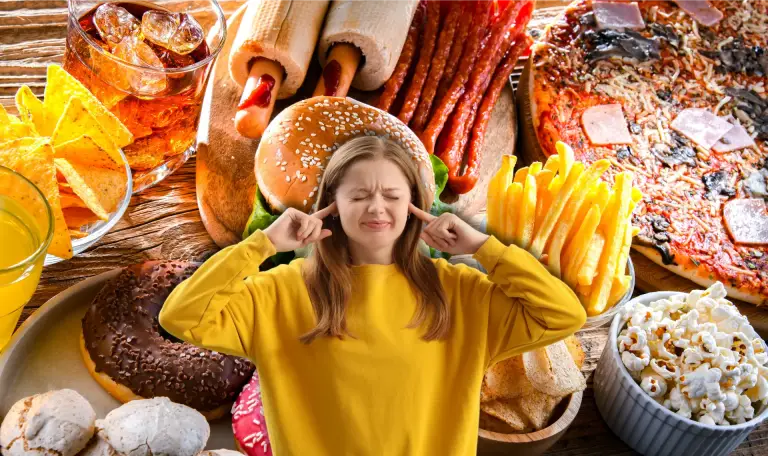
A new survey in the news this week shows that roughly 1 in 5 American adults (about 18%) say they often or always experience “food noise” — persistent, unwanted thoughts about food that crowd out everything else. If you’ve lived with that mental chatter, the survey is validating: you’re not weak, you’re not alone, and there’s now a number on it.
But here’s what the coverage mostly skipped: the term “food noise” didn’t come from science. It surfaced on social media around 2023, and the tools used to measure it are still provisional. And in this very survey, the single strongest predictor of food noise wasn’t GLP-1 status — it was loss-of-control eating, a well-established clinical construct with decades of actual research behind it. The new label is renaming something science has been tracking all along.
The survey also found something that casts doubt on the GLP-1 ads: current GLP-1 users report more food noise than non-users — not less — even after adjusting for other factors. That isn’t proof the ads are lying; it’s what you’d expect if the people most challenged by food noise are exactly the people who end up trying these drugs. But it does mean the “silence your food noise” pitch is selling you a story the science hasn’t finished testing.
Before you accept a diagnosis from an influencer, check the details that matter.
The feeling is real. The construct is new, unvalidated, and the loudest claims about it come from people selling something.
Researchers analyzed a nationally representative survey of about 1,000 US adults (Hayashi & Masterson, Obesity Science & Practice, 2026). The data came from a survey panel (Verasight) provided free to researchers; the authors declare no conflicts of interest. About 18% reported often/always experiencing food noise; about half experience it at least sometimes — which is itself a hint that we’re describing a common human experience, not a diagnosis. The strongest predictor by far was loss-of-control eating — about six times the odds (OR = 5.95), dwarfing every other factor in the model. That is significant because loss-of-control eating is a studied, treatable behavioral pattern — which means the “new” phenomenon is pointing at a known, existing one. One caveat: this analysis is exploratory — food noise was measured with a single survey item — so treat the numbers as a first look, not as settled fact.
Then the puzzle: current GLP-1 use was associated with more reported food noise (OR = 1.60), not less. Before reading that as a paradox, read the study authors’ own interpretation: it is “likely explained by selection rather than treatment effect” — the people who seek out or get prescribed GLP-1s are precisely the people whose food noise drove them there. The survey is a snapshot; it can’t show you the before and after in the same person.
And on the before-and-after question, the evidence that exists — while imperfect — points toward the drugs helping. In the INFORM survey of 550 semaglutide users, constant food thoughts fell from 62% before the drug to 16% during it (recalled food-noise scores dropped from a median of 13/20 to 6/20), with high treatment satisfaction. But that study was authored by Novo Nordisk employees, and retrospective recall from people who’ve already decided the drug worked is exactly where memory bias lives. Alongside it, a placebo-controlled trial found semaglutide reduced food cravings versus placebo on a validated questionnaire (Friedrichsen et al., 2021) — improvements that persisted to two years in follow-up analysis. What’s still missing is a proper prospective study measuring the same people before and during treatment. The fair verdict: the marketing gets ahead of the science, but the drug’s benefit for food thoughts isn’t invented from nothing.
Meanwhile, psychologists building the measurement tools say it plainly: the construct is new, partially overlaps existing ones (cravings, food preoccupation), and “very little is known.” One conceptual paper formally subsumes food noise under existing food-cue-reactivity theory — real, established phenomenon, in a new wrapper.
What this means for you: the mental chatter of food noise is real, and you don’t need a new diagnosis to validate it. The behaviors that quiet food-cue reactivity are established, and part of iDiet canon: regular meal timing, protein and fiber at every meal to help fullness signals do the talking, and environmental design that puts distance between you and the cue. Structure, not suffering.
Citations:
Hayashi D, Masterson TD. “Prevalence and Correlates of Perceived Food Noise Among U.S. Adults in a Nationally Representative Sample.” Obesity Science & Practice. 2026. DOI: 10.1002/osp4.70201
Arnaut B, et al. “Retrospective Assessment of Food Noise Changes After Initiation of Injectable Semaglutide for Weight Management in the USA: The INFORM Survey.” Advances in Therapy. 2026. PMC13415491
Friedrichsen M, et al. “The effect of semaglutide 2.4 mg once weekly on energy intake, appetite, control of eating, and gastric emptying in adults with obesity.” Diabetes, Obesity and Metabolism. 2021. PMC7898914
Hayashi et al. “What Is Food Noise? A Conceptual Model of Food Cue Reactivity.” 2025.
The anti-food-noise dinner, built on the survey’s own logic. The strongest predictor of food noise was loss-of-control eating — and nothing shuts down loss-of-control like a huge, hot, slow bowl of food that’s genuinely filling. This is an example of iDiet volume in practice: an enormous serving of spiced spinach gravy with chewy pan-fried tofu, where one overflowing bowl costs about 300 calories.
Multiply it by 4 or 6, eat it all week, and freeze some for food emergencies.
Ingredients (1 serving, 300-calorie tier)
Method
Per serving: about 300 calories, 28g protein, 12g fiber. The full recipe scales across all five iDiet calorie tiers, if you’re in an iDiet program.
Why this fits iDiet: the bowl is mostly liquid, fiber, and protein — a full stomach sends the satiety signals that crowd out food thoughts far better than willpower does. And a hot, spiced, sit-down meal you actually enjoy is the behavioral opposite of the grazing pattern the survey flagged as food noise’s closest companion.
Practical tip: frozen spinach is the volume secret — 1 cup thawed and drained equals about 4 cups fresh, and it’s already portioned in the bag. This cooks in 20 minutes, most of it unattended.
Curious to learn more? See our programs here. More about OnDemand. Read Results and Testimonials. More about the science here.